

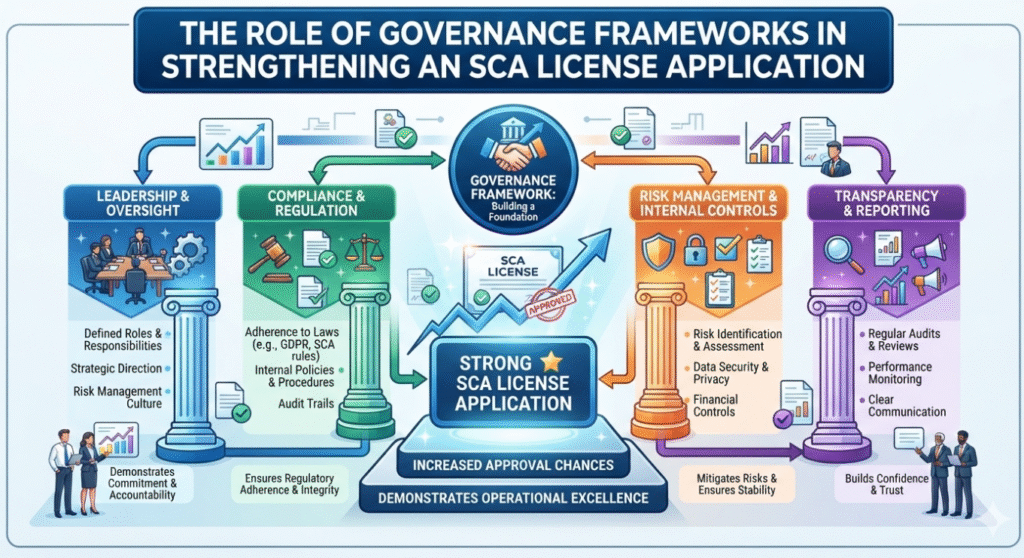
Understanding Why Governance Matters in the Licensing Process
Obtaining an SCA license in the UAE requires more than submitting corporate documents and demonstrating that a business meets basic financial or operational requirements. Regulatory authorities need confidence that an applicant has established a sustainable structure capable of operating responsibly within a highly regulated financial environment. This is where a robust governance framework becomes a central part of application readiness. Governance establishes how decisions are made, who holds responsibility, how risks are escalated, and how the organization maintains accountability across its operations. A well-developed framework demonstrates that compliance is embedded into the business model rather than being treated as a requirement addressed only during the licensing process. The Securities and Commodities Authority has consistently emphasized governance, transparency, internal controls, and clearly defined responsibilities as important elements of a well-regulated market environment.
For an applicant, governance can help transform a collection of policies and organizational charts into a coherent operational system. It provides a structured relationship between shareholders, directors, senior management, compliance personnel, and other control functions. When these relationships are unclear, regulatory concerns can arise regarding oversight, conflicts of interest, decision-making authority, and risk ownership. A strong governance framework addresses these questions before they become regulatory issues. It also creates consistency between the company’s business plan, organizational structure, compliance policies, and practical operating model. This consistency can significantly strengthen the overall credibility of an SCA license application.
Creating Clear Roles and Accountability Across the Organization
One of the most important purposes of governance is establishing clear accountability throughout the organization. A regulated financial services business cannot rely on informal decision-making structures or overlapping responsibilities between key individuals. Regulators expect applicants to demonstrate who is responsible for strategic oversight, operational management, regulatory compliance, risk management, and internal controls. Each function should have a defined mandate and appropriate authority to perform its responsibilities effectively. Clear reporting lines also make it easier to demonstrate that important issues can be escalated to the appropriate level of management or oversight. When accountability is documented properly, the licensing application presents the organization as structured, disciplined, and prepared for regulatory supervision.
The board and senior management structure should therefore reflect the actual nature and complexity of the proposed regulated activity. Governance documentation should explain how key decisions will be approved and who has authority over different areas of the business. Delegation of authority matrices can provide additional clarity by identifying financial, operational, and compliance-related approval responsibilities. This reduces ambiguity and helps prevent decisions from being made without proper oversight. A clearly structured organization also allows compliance and risk personnel to understand where their responsibilities begin and where other functions take ownership. Effective governance is ultimately about ensuring that responsibility can be traced, monitored, and enforced throughout the organization.
Aligning Corporate Structure With Regulatory Expectations
Corporate structuring and governance should never be developed as separate exercises when preparing an SCA license application. The legal structure of the business directly affects ownership, management responsibilities, reporting relationships, and control mechanisms. A governance framework should therefore be designed around the actual corporate structure rather than copied from a generic compliance template. This requires careful consideration of shareholders, directors, senior executives, committees, and regulated control functions. Each component should have a legitimate purpose and clearly defined relationship with the others. A disconnected structure can create inconsistencies that may weaken the overall application.
The SCA’s broader regulatory approach to governance reflects the importance of clearly defined organizational structures, policies, procedures, and management responsibilities. Certain SCA regulations explicitly reference governance provisions that include organizational structures, processes, procedures, and policies under which boards and management operate. This highlights why applicants should view governance as an operational architecture rather than simply a corporate formality. The structure should demonstrate that the organization can maintain effective oversight as it grows and as its regulatory obligations become more complex. It should also support transparency between ownership interests and management responsibilities. When corporate structuring and governance are properly aligned, the application becomes more internally consistent and easier to assess.
Strengthening Risk Management Before Operations Begin
Risk management is another critical area where governance plays a significant role. An SCA license applicant should be able to identify the risks associated with its proposed activities and demonstrate how those risks will be monitored and managed. Governance provides the framework through which risk ownership and escalation are established. Without clear governance, even a detailed risk policy may have limited practical value because employees may not understand who is responsible for responding to specific risks. A structured framework ensures that risks can move from operational teams to senior management and oversight bodies when necessary. This creates a more resilient organization from the beginning of its regulated operations.
An effective risk governance structure should also distinguish between identifying risks and managing them. Business teams may own certain operational risks, while senior management may oversee broader strategic risks and dedicated control functions may independently monitor specific areas. The framework should establish how risk assessments are performed, how frequently they are reviewed, and how significant issues are reported. It should also explain the process for implementing corrective actions when weaknesses are identified. This demonstrates that risk management is not a static document created for the application. Instead, it becomes an ongoing management process that supports regulatory compliance and operational stability.
Building Independence Into Compliance and Control Functions
A strong governance framework recognizes that compliance cannot operate effectively when it lacks sufficient independence. Compliance personnel need clear authority, access to relevant information, and the ability to escalate concerns without inappropriate interference. The same principle applies to other control functions that may be required based on the nature of the regulated activity. Governance documentation should therefore define reporting relationships and ensure that control functions are positioned appropriately within the organization. If compliance responsibilities are buried within purely commercial functions, questions may arise about the effectiveness of independent oversight. Clear functional independence helps demonstrate a genuine commitment to regulatory obligations.
This does not mean that compliance should operate separately from the rest of the business. Effective compliance requires close communication with operational and senior management teams. However, governance should provide mechanisms that allow compliance concerns to receive appropriate attention when commercial priorities and regulatory obligations conflict. Escalation procedures, reporting arrangements, committee structures, and documented management responses can all support this objective. The organization should also establish how compliance findings are tracked and resolved over time. A mature governance structure ensures that identified issues lead to accountability and corrective action rather than simply being recorded.
Managing Conflicts of Interest Through Formal Governance
Conflicts of interest are particularly important in regulated financial environments because they can affect decision-making, client relationships, market integrity, and stakeholder confidence. A strong governance framework establishes procedures for identifying, disclosing, assessing, and managing actual or potential conflicts. This process should apply not only to employees but also to directors, senior management, shareholders, and relevant third parties. The framework should explain who reviews disclosed conflicts and what measures may be implemented to mitigate them. Depending on the circumstances, these measures may include restrictions, recusal procedures, enhanced oversight, or other appropriate controls. The objective is to demonstrate that conflicts are managed systematically rather than informally.
Formal conflict management also improves transparency throughout the organization. Directors and senior executives should understand their responsibilities regarding disclosure and participation in decisions where personal interests could influence their judgment. Policies should be supported by practical procedures rather than broad statements of principle alone. The organization should know how disclosures are recorded, reviewed, and periodically reassessed. Governance mechanisms can also help identify conflicts arising from related-party relationships and complex ownership arrangements. By addressing these issues before commencing regulated activities, an applicant demonstrates stronger institutional discipline and a more mature approach to regulatory risk.
Establishing Effective Oversight Through Committees and Reporting
Governance becomes more effective when there are appropriate mechanisms for oversight and structured communication. Depending on the nature, size, and complexity of the applicant, this may involve committees or other formal management forums responsible for reviewing specific areas of risk and compliance. The purpose is not simply to create additional meetings or administrative processes. Effective oversight forums provide a documented environment where important issues can be reviewed, challenged, and escalated. They also create a record showing that management and oversight bodies are actively engaged with key regulatory responsibilities. This can be particularly valuable in demonstrating that governance operates in practice rather than existing only on paper.
Regular reporting is equally important because oversight depends on access to relevant information. Senior management and directors should receive information that allows them to understand compliance performance, risk exposures, control weaknesses, and material incidents. Reports should be proportionate to the business and sufficiently detailed to support informed decisions. Governance should also establish how often reports are produced and what happens when significant concerns are identified. Clear reporting processes help prevent important issues from remaining isolated within individual departments. They create an environment where regulatory responsibilities are monitored collectively and addressed through accountable decision-making.
Connecting Policies to Real Operational Practices
One common weakness in licensing preparation occurs when companies develop comprehensive policies that are not connected to their actual operations. A governance framework helps prevent this problem by creating ownership and implementation responsibilities for every significant policy. Policies relating to compliance, risk management, conflicts of interest, financial crime prevention, information security, and internal controls should all have clearly identified owners. Those responsible should understand how the policy affects daily activities and what evidence will demonstrate implementation. This creates a direct connection between written requirements and operational behavior. A regulator reviewing the application can therefore see that the applicant has considered how its framework will function after authorization.
Operational alignment is especially important because regulated firms must maintain compliance on an ongoing basis. The licensing application is only the beginning of the regulatory relationship. Policies that cannot realistically be implemented may quickly become a source of future compliance weaknesses. Governance provides a mechanism for reviewing policies, updating them as the business evolves, and assigning responsibility for implementation. It also creates a process for identifying gaps between documented procedures and actual practices. By designing governance around practical implementation, applicants can build a framework that remains useful long after the licensing process is complete.
Demonstrating a Culture of Regulatory Responsibility
Governance is not limited to organizational charts, committees, and policies. It also influences the culture of the organization by establishing expectations regarding ethical conduct and regulatory responsibility. Senior leadership plays a particularly important role because employees often follow the standards demonstrated by management. When leadership treats compliance as a strategic responsibility, this approach is more likely to influence decision-making throughout the business. Conversely, when compliance is viewed solely as an administrative requirement, employees may prioritize commercial objectives over regulatory obligations. A strong governance framework helps establish the appropriate tone from the top.
This cultural dimension can be supported through training, internal communication, documented accountability, and regular management engagement. Employees should understand the importance of escalating concerns and reporting potential compliance issues. Management should demonstrate that raising legitimate concerns will lead to constructive assessment rather than inappropriate consequences. Governance can also establish expectations for ethical conduct and professional behavior across the organization. Over time, these principles help create a stronger compliance culture that supports sustainable regulatory operations. For an SCA license applicant, demonstrating this mindset can reinforce the credibility of the entire governance and compliance architecture.
Improving Application Consistency and Regulatory Readiness
An SCA license application involves multiple documents that should communicate a consistent story about the proposed business. The business plan should align with the organizational structure, while the organizational structure should align with governance arrangements. Governance policies should correspond with the responsibilities assigned to key personnel, and risk frameworks should reflect the actual activities described in the application. When these documents are prepared independently, inconsistencies can emerge that create unnecessary questions during regulatory review. A governance-led approach helps ensure that every component is developed within a common framework. This improves both the quality and coherence of the overall application.
Regulatory readiness should therefore begin with a detailed assessment of the business model and its proposed operating environment. From there, governance responsibilities can be mapped across leadership, management, compliance, and operational teams. Policies and procedures can then be developed to support those responsibilities. This approach is generally more effective than preparing documentation in isolation and attempting to connect it later. It also makes it easier to identify gaps before the application is submitted. Strong governance preparation can therefore improve not only the quality of documentation but also the organization’s confidence in its ability to meet ongoing regulatory obligations.
Governance as a Foundation for Long-Term Compliance
The strongest governance frameworks are designed for the full lifecycle of a regulated business rather than solely for initial licensing approval. After authorization, firms face continuing obligations that may involve regulatory reporting, internal reviews, policy updates, risk assessments, and responses to evolving requirements. A governance framework provides the structure needed to manage these responsibilities consistently over time. It also helps organizations adapt when they introduce new services, expand into additional markets, or experience changes in ownership or senior management. Without this foundation, growth can create fragmented decision-making and increased compliance risk. Governance therefore supports both regulatory resilience and sustainable commercial development.
At Keepers Compliance, we recognize that a successful licensing strategy must consider what happens after approval as carefully as the application itself. We work with businesses to develop structures that support both regulatory authorization and ongoing operational compliance. Our approach considers the relationship between governance, corporate structure, compliance obligations, risk management, and practical business operations. This helps clients move beyond a document-focused approach toward a more integrated compliance architecture. By building governance into the foundation of the organization, we help create stronger systems for accountability and regulatory engagement. The goal is to support businesses that are prepared not only to apply for authorization but also to operate responsibly once licensed.
The Strategic Value of Professional Governance Preparation
Developing a governance framework requires more than adapting generic templates to fit a regulatory application. Every organization has a different ownership structure, business model, management team, risk profile, and proposed scope of regulated activities. The governance model should reflect these realities while remaining aligned with applicable regulatory expectations. Professional preparation can help identify structural gaps and inconsistencies before they affect the licensing process. It can also ensure that governance documentation works cohesively with compliance manuals, risk policies, organizational charts, and business plans. This level of integration can significantly improve the overall quality and credibility of an application.
Keepers Compliance supports firms requiring specialized assistance with SCA and VARA licensing and ongoing regulatory compliance in the UAE. We help clients approach licensing as a structured regulatory journey rather than a standalone documentation exercise. Our work focuses on building practical frameworks that connect corporate governance with risk management, compliance oversight, and sustainable operational processes. This allows businesses to establish a clearer foundation for engaging with regulatory requirements throughout their lifecycle. A well-designed governance framework ultimately demonstrates preparedness, accountability, and institutional maturity. For businesses pursuing an SCA license, these qualities can become an important part of building a stronger and more credible application from the very beginning.