

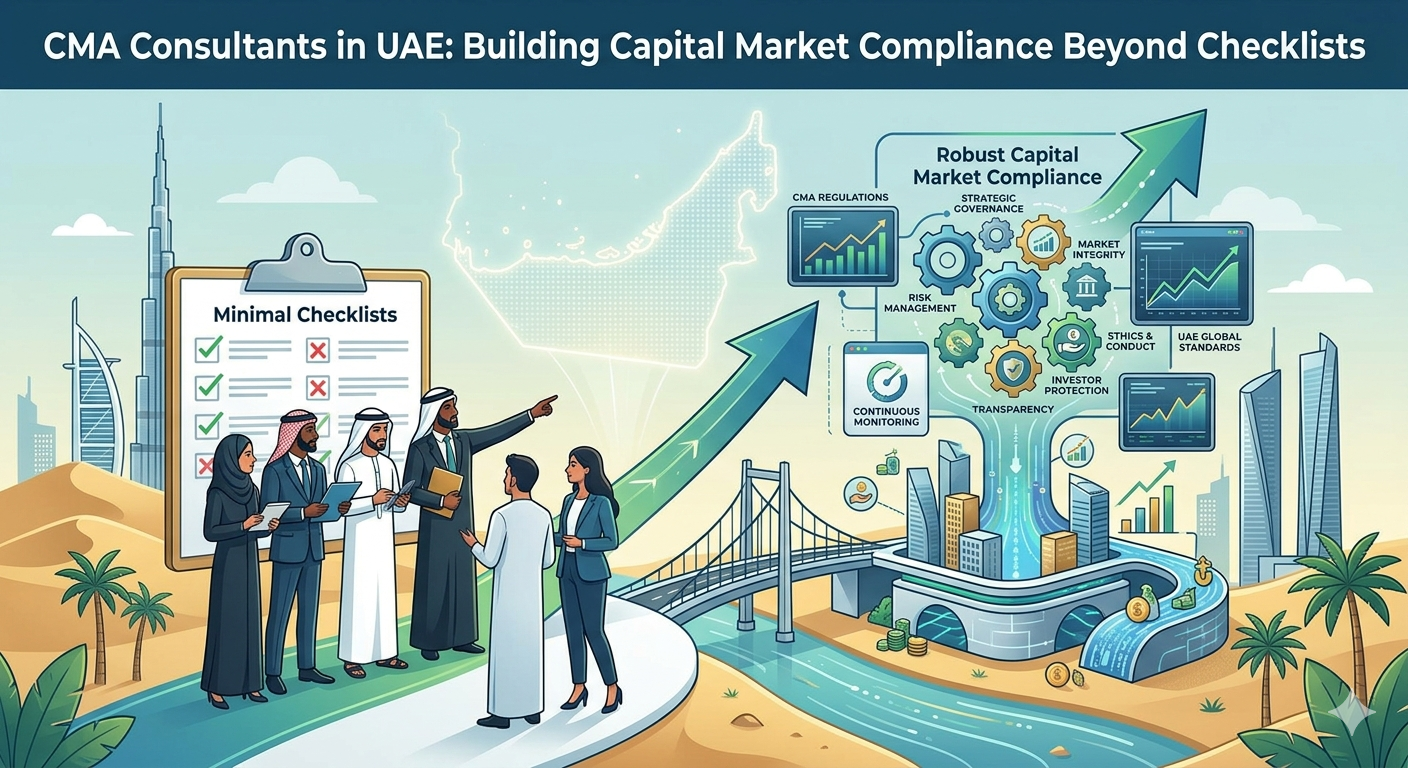
CMA Consultants in UAE
In the modern financial ecosystem, regulatory alignment is no longer a periodic obligation. It is a continuous design principle that shapes how firms operate, raise capital, and sustain investor trust. At Keepers Compliance, we approach CMA consulting in the UAE as a strategic discipline rather than a documentation exercise.
We support organizations that interact with Capital Market Authority frameworks, particularly those operating across GCC-linked investment corridors where regulatory expectations are converging, even when jurisdictional boundaries differ. Our work focuses on translating regulation into operational systems that actually function inside real businesses.
This blog explores how CMA consulting should be understood today, why traditional compliance models are failing, and how we help institutions build resilient capital market structures.
Rethinking CMA Compliance in a Cross Border Financial Environment
Capital market regulation in the region is evolving rapidly. While the Capital Market Authority is formally associated with Saudi Arabia, its regulatory influence extends into broader GCC investment behavior, especially in UAE based financial advisory firms, asset managers, fintech platforms, and cross border fundraising structures.
The challenge for most firms is not awareness of regulation. The challenge is interpretation under complexity.
Most compliance programs still treat CMA requirements as static rulebooks. In reality, capital market oversight is dynamic, data driven, and deeply connected to investor protection mechanisms, governance transparency, and disclosure discipline.
At Keepers Compliance, we treat CMA consulting as a bridge between regulatory intent and business execution.
The Core Problem Most Firms Do Not Recognize
Many organizations believe compliance failure happens at the reporting stage. In practice, it begins much earlier.
We consistently observe four structural gaps:
1. Compliance is isolated from product design
2. Regulatory interpretation is outsourced but not internalized
3. Documentation exists without operational enforcement
4. Risk controls are reactive instead of embedded
This creates a situation where firms appear compliant on paper but remain exposed during audits, licensing reviews, or capital structuring evaluations.
Our CMA consulting model is designed to eliminate this gap between paper compliance and operational reality.
What CMA Consultants Actually Do When Done Correctly
A meaningful CMA consulting framework is not limited to advisory notes or licensing assistance. It functions across three integrated layers.
1. Regulatory Architecture Design
We map applicable CMA expectations against the client’s business model. This includes:
• Investment advisory structures
• Fund formation and distribution models
• Cross border capital flow structures
• Governance frameworks for decision making
The objective is to ensure compliance is structurally embedded, not appended.
2. Control System Engineering
Once the architecture is defined, we translate regulatory requirements into enforceable internal controls.
This includes:
• Approval hierarchies for investment decisions
• Risk scoring mechanisms for client onboarding
• Transaction monitoring logic aligned with capital market standards
• Disclosure workflows for material information
Instead of asking whether a firm is compliant, we design systems that ensure it remains compliant automatically.
3. Regulatory Communication Strategy
One of the most overlooked aspects of CMA consulting is regulator facing communication.
We help firms prepare:
• Licensing narratives
• Audit readiness documentation
• Regulatory response frameworks
• Structured disclosure reports
The goal is to ensure clarity under scrutiny, not improvisation under pressure.

Why UAE Based Firms Face Unique CMA Related Complexity
Even though the UAE has its own securities regulator, many firms operate in hybrid environments involving:
• Saudi investor participation
• GCC cross listing structures
• Regional fund distribution networks
• Dual jurisdiction advisory mandates
This creates overlapping expectations where CMA related standards often become a reference benchmark for governance quality, even outside Saudi jurisdiction.
We help firms interpret these overlaps correctly so they do not over comply in some areas while under complying in others.
Common Mistakes We Correct in CMA Advisory Engagements
Across our consulting work, we repeatedly encounter predictable errors:
Treating compliance as a legal department function
Compliance must sit at the intersection of operations, product, and finance, not be isolated in legal teams.
Over reliance on external advisors
External consultants can interpret regulation, but internal teams must operationalize it.
Static policy documentation
Policies that do not evolve with business models quickly become irrelevant during regulatory review.
Weak capital market governance mapping
Many firms fail to clearly define how investment authority flows within the organization.
We address these issues by embedding compliance thinking into business design itself.
Our Approach at Keepers Compliance
At Keepers Compliance, our CMA consulting methodology is built on three principles:
Precision Over Volume
We do not produce excessive documentation. We focus on actionable compliance structures that reduce ambiguity.
Systems Over Statements
We prioritize building control systems instead of writing compliance statements that sit unused.
Sustainability Over Certification
Our objective is not just to pass regulatory checks but to create long term regulatory stability.
We work with firms to ensure compliance becomes part of their operating DNA.
The Future of CMA Consulting in the Region
The direction of capital market regulation is clear. Authorities are moving toward:
• Real time reporting expectations
• Data driven compliance monitoring
• Stronger investor protection frameworks
• Increased scrutiny of cross border financial activity
This means traditional compliance models will gradually lose effectiveness.
The future belongs to firms that can integrate regulatory logic into their operational infrastructure.
CMA consultants will no longer be document reviewers. They will function as system designers for regulatory resilience.
CMA consulting in the UAE context is not simply about understanding rules. It is about engineering business models that remain stable under regulatory evolution.
At Keepers Compliance, we focus on building that stability. We help organizations move from reactive compliance to structured regulatory intelligence, ensuring they are prepared not just for current expectations but for what comes next in capital market governance.
If compliance is treated as infrastructure rather than obligation, it stops being a constraint and becomes a strategic advantage.